Engineering Success Center tutor encourages active participation for best tutoring success
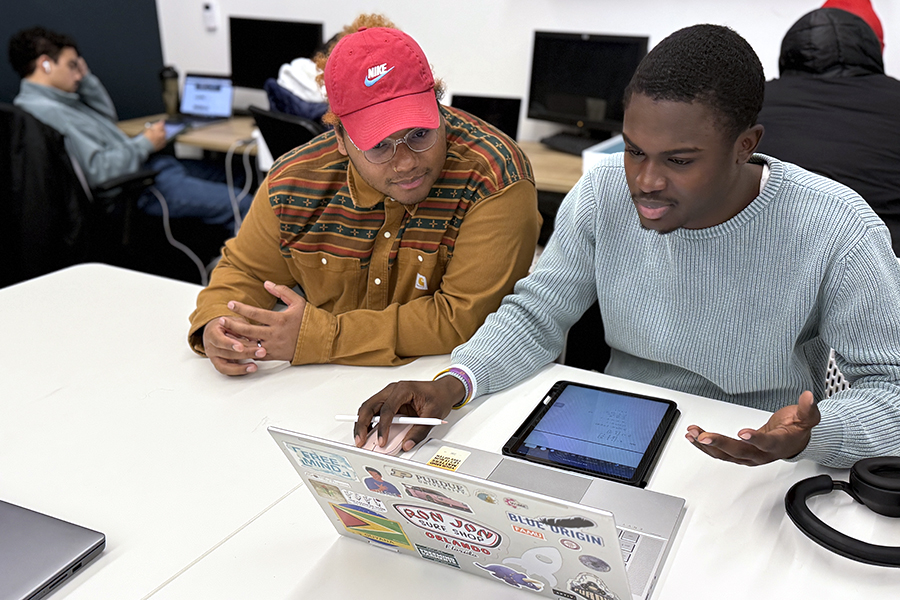
When a student comes to the Engineering Success Center (ESC) for D’Angelo Peters’ chemistry tutoring, the problem isn’t the first thing Peters asks about.
He starts by asking about passions. The first few minutes are dedicated to positive, big picture and relationship building before working through homework and practice tests.
It’s exactly what Peters intends.
“I want to connect to students on a human level before I ease them into the paradigm shift they need to succeed in chemistry,” said Peters, who currently is pursuing a PhD.
While students might not consider tutoring to contain paradigm shifts — major changes in thought processes — Peters’ master’s in science education taught him to look at the roots of students, including mindsets, goals, family support and attitudes toward education.
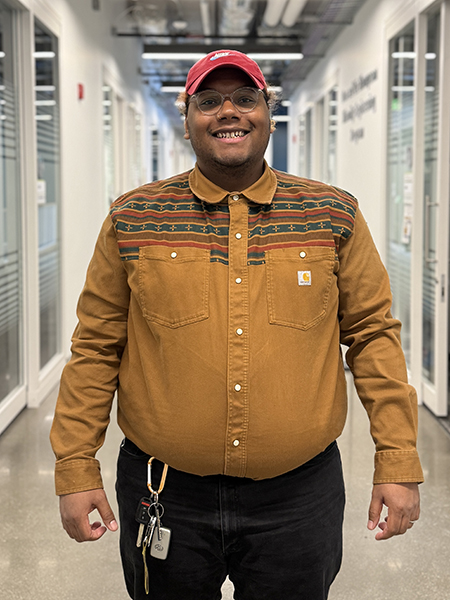
A conflicting paradigm is actually how he started tutoring chemistry in the first place. Peters watched peers and friends struggle with general chemistry throughout college, and it wasn’t simply because it was too difficult: They didn’t see the point in learning chemistry. When were they ever going to balance chemical equations, diagram carbon molecules or need to know what an actinide was?
Peters saw the relevance of each assignment, even past his undergraduate chemistry degree: The skills each seemingly trivial task taught could be adapted to other disciplines. The thought process chemistry taught could easily help engineers succeed in other classes.
Peters tutored friends in undergrad from 2016-2020. After completing the first year of grad school, Peters was invited by Department of Chemistry instructional specialist Marybeth Miller to provide support for incoming first-year students in Engineering Academic Boot Camp in the summer of 2021. Peters began tutoring in August that same year.
It only took a few months for engineering students to seek Peters out for his inspiring and helpful tutoring over the next three years. One student was — and still is — Purdue football player DJ Greene. Greene first met Peters in 2024 while taking organic chemistry.
“I like going to D’Angelo because he’s personable and easy to talk to,” Greene said. “I can text him outside of our sessions about questions, too, and he sends me all of the resources used in session so I can have them for the future.”
Peters cultivates a comfortable atmosphere to explore chemistry in a collaborative way. For students who are actively seeking to learn, tutoring through ESC is the prime space to challenge themselves to learn new concepts and test problem solving abilities and concept application.
“Every student I meet is a new way to think about chemistry,” Peters said. “And if I fail to help them see (chemistry) from their perspective, then I am not doing my job.”
Peters mentioned he was proud of a recent student who was working through a Born-Haber equation — a calculation of lattice energy of ionic compounds generated by a metal bonding with a non-metallic element — during a session. After the pair talked through the concept, the student plotted the problem on a whiteboard in Lambertus Hall, Room 2235. Within a few seconds of standing back and looking at the work, the student found the mistake without Peters pointing it out.
Those lightbulb moments signal a shift in a students’ paradigm: It’s a small step in the transition from chemistry feeling impossible to chemistry being doable.
“My goal is to demystify chemistry and help students gain problem solving and critical thinking,” Peters said. “If we have those two things, and even 1% of progress, it’s all progress and should be celebrated.”
Chemistry isn’t the only skill Peters is excited to teach students. He also offers frequent advice about networking into research, setting up a good email signature and digital etiquette that can make or break a network connection.
And how to talk about research and a degree path in a sentence or less to a recruiter or interviewer.
It’s not one-sided work, Peters mentioned. He encourages students to get comfortable engaging with tutors and the ESC community, even when they’re doing well in a course.
“Look around the (ESC study) room,” Peters said. “These are people that can support you, but you have to ask them to help you. Being a part of the community to get help when you need it is one of the best things you can do for yourself.”
The Engineering Success Center houses a collaborative learning environment through tutoring, faculty-led concept deep dives and exam preparation sessions. ESC provides a physical space for students to study, ask questions and learn together with 17 available tutors in over 40 engineering and engineering-related subjects. Located in Lambertus 2235, the area is open to students from 8 a.m.-8 p.m. for teamwork and individual study.